
 Image 1 of 1
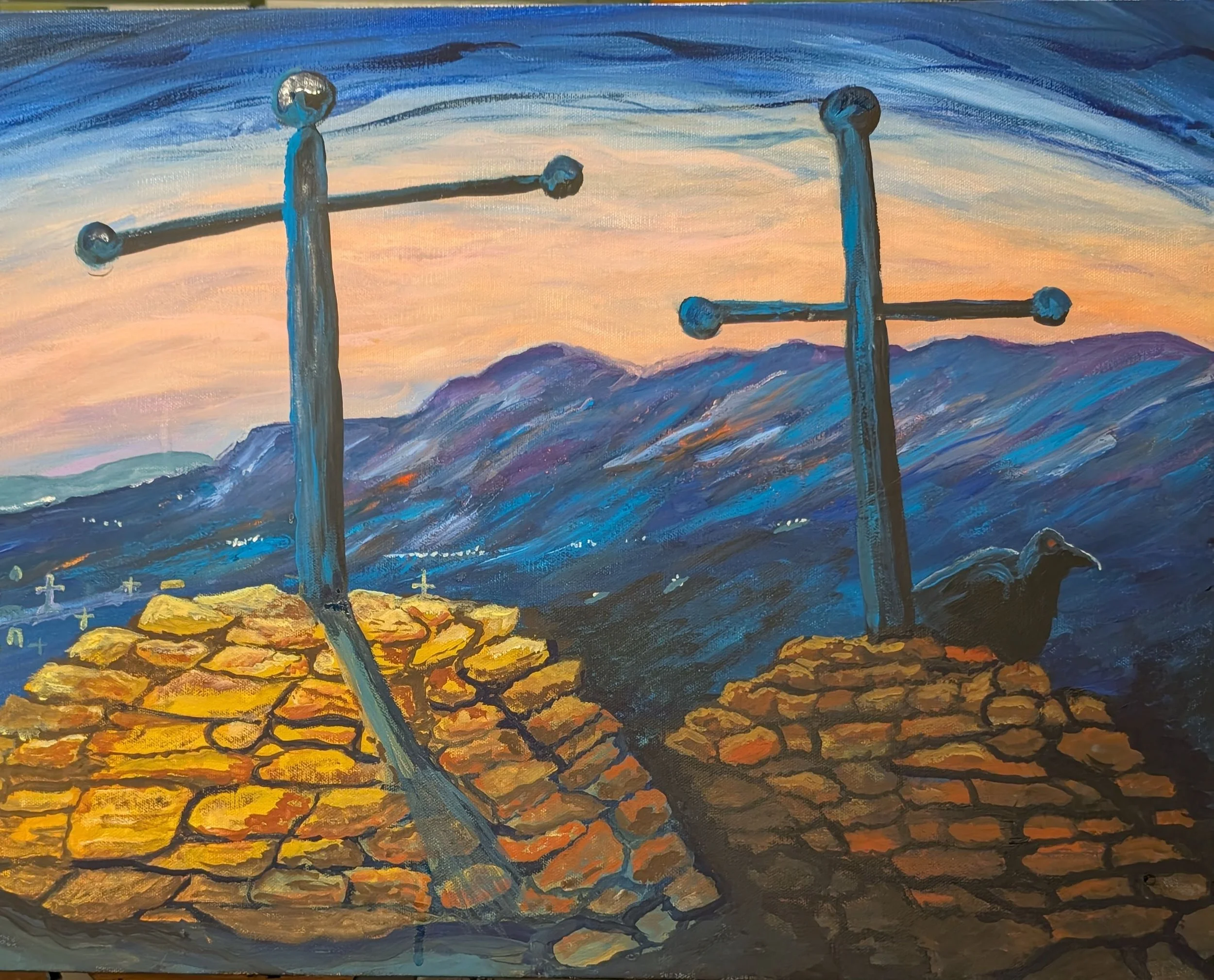
Terlingua Macabre
Artwork Specifications
* Dimensions: 18" x 24" x 1.5"
* Medium: Opaque gouache on gallery-wrapped canvas prepped with absorbent watercolor ground
* Sides: Painted continuous with the composition (ready to hang without framing)
* Subject: Historic Terlingua Cemetery, Chisos Mountains, Big Bend region
Description & Artistic Vision
Perched on the liminal threshold between the sun-scorched earth and an encroaching indigo dusk, Terlingua Macabre captures the haunted, sacred isolation of the historic ghost town cemetery in Brewster County. Rather than relying on documentary realism, the work transforms the rugged Chihuahuan Desert into a psychic, dreamlike landscape charged with silent tension.
Two dry-stacked stone burial cairns rise from the foreground, crowned by weathered wooden crosses with stylized, rounded arms that bisect the desert floor and vault into the sky. On the right cairn, a lone raven sits in quiet watch—an enduring symbol of the macabre, mystery, and spiritual guardianship. As twilight sweeps across the Chisos range, sharp staccato sparks of cool white light flicker along the base of the mountains, hinting at distant habitations, lone headlamps, or lingering desert energy against the darkening valley floor.
Influences & Dialogue
Rooted in the visual language of late 19th- and early 20th-century Expressionism, the composition channels the emotive intensity of Edvard Munch and the raw, saturated palettes of the German Die Brücke movement (such as Ernst Ludwig Kirchner and Karl Schmidt-Rottluff). The color is non-naturalistic and symbolic: the left cairn burns with an internal, high-voltage cadmium and amber glow—treating the desert grave not as a cold marker of decay, but as a luminous reliquary holding the day's radiant heat. This hyper-vivid warmth clashes against deep cobalt, violet, and chromatic black shadows, creating an unsettling yet reverent atmosphere where physical terrain and spiritual mystery meet.
Process & Medium
Synthesized from multiple photographic studies of the Terlingua Cemetery, the piece was built on a 1.5-inch deep gallery canvas hand-prepped with watercolor ground to establish a receptive, toothy surface.
The painting began with a vibrant, warm underpainting to embed an inner glow into the lower layers of the composition. Broad, scumbled sweeps of cool midnight blues and soft, coral-tinted sky washes established the atmospheric vault, contrasting the knife-edge silhouette of the mountain crest. Using opaque gouache applied with both broad gestural strokes and fine calligraphic line work, deep chromatic darks mixed from ultramarine and burnt umber were carved into the fissures of the hand-stacked stones. Layered pale-yellow and dusty terracotta highlights catch the raking twilight along the stone rims, while a soft, elongated cast shadow reaches downward to fuse the monument seamlessly with the
desert floor.
Terlingua Macabre
Artwork Specifications
* Dimensions: 18" x 24" x 1.5"
* Medium: Opaque gouache on gallery-wrapped canvas prepped with absorbent watercolor ground
* Sides: Painted continuous with the composition (ready to hang without framing)
* Subject: Historic Terlingua Cemetery, Chisos Mountains, Big Bend region
Description & Artistic Vision
Perched on the liminal threshold between the sun-scorched earth and an encroaching indigo dusk, Terlingua Macabre captures the haunted, sacred isolation of the historic ghost town cemetery in Brewster County. Rather than relying on documentary realism, the work transforms the rugged Chihuahuan Desert into a psychic, dreamlike landscape charged with silent tension.
Two dry-stacked stone burial cairns rise from the foreground, crowned by weathered wooden crosses with stylized, rounded arms that bisect the desert floor and vault into the sky. On the right cairn, a lone raven sits in quiet watch—an enduring symbol of the macabre, mystery, and spiritual guardianship. As twilight sweeps across the Chisos range, sharp staccato sparks of cool white light flicker along the base of the mountains, hinting at distant habitations, lone headlamps, or lingering desert energy against the darkening valley floor.
Influences & Dialogue
Rooted in the visual language of late 19th- and early 20th-century Expressionism, the composition channels the emotive intensity of Edvard Munch and the raw, saturated palettes of the German Die Brücke movement (such as Ernst Ludwig Kirchner and Karl Schmidt-Rottluff). The color is non-naturalistic and symbolic: the left cairn burns with an internal, high-voltage cadmium and amber glow—treating the desert grave not as a cold marker of decay, but as a luminous reliquary holding the day's radiant heat. This hyper-vivid warmth clashes against deep cobalt, violet, and chromatic black shadows, creating an unsettling yet reverent atmosphere where physical terrain and spiritual mystery meet.
Process & Medium
Synthesized from multiple photographic studies of the Terlingua Cemetery, the piece was built on a 1.5-inch deep gallery canvas hand-prepped with watercolor ground to establish a receptive, toothy surface.
The painting began with a vibrant, warm underpainting to embed an inner glow into the lower layers of the composition. Broad, scumbled sweeps of cool midnight blues and soft, coral-tinted sky washes established the atmospheric vault, contrasting the knife-edge silhouette of the mountain crest. Using opaque gouache applied with both broad gestural strokes and fine calligraphic line work, deep chromatic darks mixed from ultramarine and burnt umber were carved into the fissures of the hand-stacked stones. Layered pale-yellow and dusty terracotta highlights catch the raking twilight along the stone rims, while a soft, elongated cast shadow reaches downward to fuse the monument seamlessly with the
desert floor.